


Gdańsk – a city of solidarity and freedom
Overview
Gdańsk is a city on the Baltic coast of northern Poland, and the capital of the Pomeranian Voivodeship. With a population of 486,492, it is Poland's sixth-largest city and its major seaport. Gdańsk lies at the mouth of the Motława River and is situated at the southern edge of Gdańsk Bay, close to the city of Gdynia and the resort town of Sopot; these form a metropolitan area called the Tricity (Trójmiasto), with a population of approximately 1.5 million.
Gdańsk was first mentioned in 997 as part of the early Polish state, and thereafter grew into a trading town under the Piast and Samboride dynasties. Shifting between Polish and Teutonic control during the Middle Ages, it subsequently joined the Hanseatic League and, with considerable autonomy, served as the Polish Crown's principal seaport and largest city until the early 18th century. With the Partitions of Poland, the city was annexed by Prussia in 1793, and was integrated into the German Empire in 1871. It was a free city from 1807 to 1814 and from 1920 to 1939. On 1 September 1939, it was the site of a military clash at Westerplatte, one of the first events of World War II. The contemporary city was shaped by extensive border changes, the expulsion of German speakers and Polish resettlement after 1945. In the 1980s, Gdańsk was the birthplace of the Solidarity trade union and movement, which helped precipitate the collapse of communism in Europe.
The city is home to the University of Gdańsk, Gdańsk University of Technology, the National Museum, the Gdańsk Shakespeare Theatre, the Museum of the Second World War, the Polish Baltic Philharmonic, the Polish Space Agency and the European Solidarity Centre. Among Gdańsk's most notable historical landmarks are the Town Hall, the Green Gate, Artus Court, Neptune's Fountain, and St. Mary's Church, one of the largest brick churches in the world. The city is served by Gdańsk Lech Wałęsa Airport, the country's third busiest airport and the most important international airport in northern Poland.
Gdańsk is one of the most visited cities in Poland, having received 4.5 million tourists in 2024, especially from Scandinavia and Germany. The city hosts St. Dominic's Fair, which dates back to 1260, and is regarded as one of the biggest trade and cultural events in Europe. In a 2019 quality of life poll, Gdańsk ranked highest among Polish cities. Its historic city centre has been listed as one of Poland's national monuments. In 2025, Gdańsk became a UNESCO City of Literature.
Sightseeing
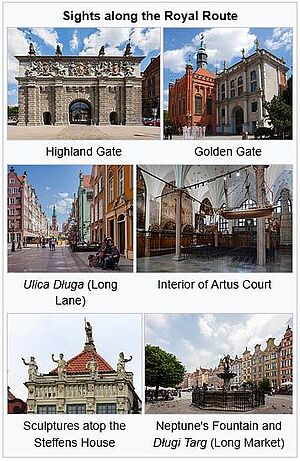
The city has many reconstructed buildings originally built in the time of the Hanseatic League, most of which are located in the Main City and specifically along or near Ulica Długa and Długi Targ, a pedestrian thoroughfare surrounded by reconstructed historical buildings and flanked at both ends by elaborate city gates; this is sometimes referred to as the Royal Route, since it was once the path of processions for visiting Kings of Poland.
Walking from end to end, sites encountered on or near the Royal Route include the Highland Gate, marking the beginning of the route, located near the Torture Chamber, Mansion of the Society of Saint George, and the Golden Gate.
Along Długa Street, Uphagen's House is found, today housing a branch of the Gdańsk Museum, which is located near the Lion's Castle and the Main City Hall. Further down the route, along the Długi Targ, the Artus Court is located, followed by Neptune's Fountain, the New Jury House, the Steffens House, and the Green Gate. Gdańsk has a number of historical churches, including St. Catherine's Church, St. Nicholas' Church and St. Mary's Church (Bazylika Mariacka). St. Mary's Church is a city church built in the 15th century, and is one of the largest brick churches in the world. The city centre within 17th-century fortifications is a Historic Monument of Poland.
Other notable sights in the historical city centre include the Royal Chapel, Gdańsk Crane, Great Armoury, granaries on Ołowianka and Wyspa Spichrzów, the John III Sobieski Monument, the Old Town Hall, Mariacka Street, the Polish Post Office, and a series of city gates. Main sights outside the historical city centre include the Abbot's Palace, Oliwa Cathedral, Brzeźno Pier, medieval city walls, Westerplatte, Wisłoujście Fortress, and Gdańsk Zoo. The Olivia Centre, found in Oliwa, includes Olivia Star, the tallest building in northern Poland, measuring 180 metres.